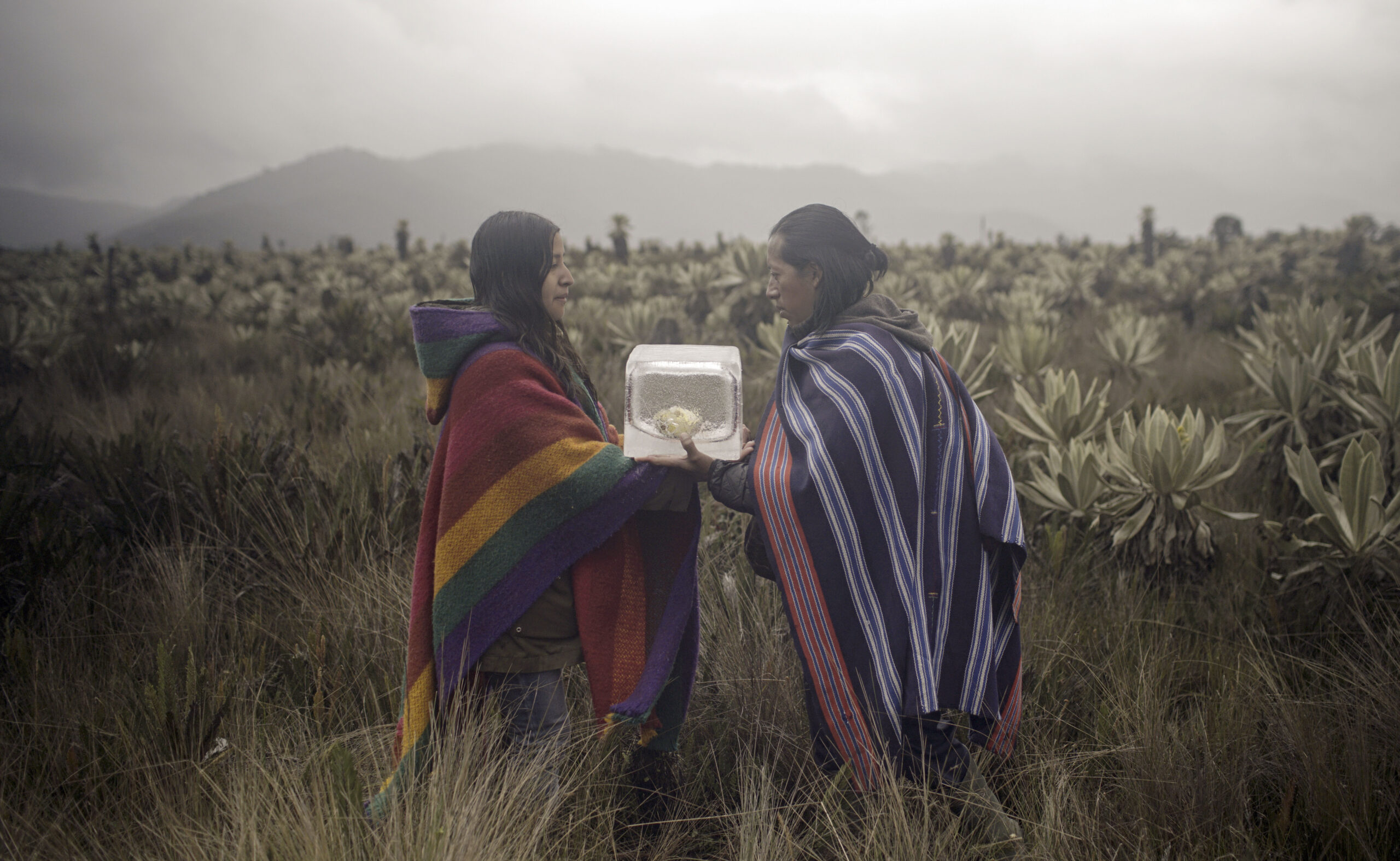
The Haus für Medienkunst Oldenburg presents Counter-Expeditions, a major solo exhibition by the Colombian-American artist, researcher and filmmaker Felipe Castelblanco. The exhibition presents several new works as well as a retrospective of his ten-year interdisciplinary practice. On display are films, video installations and photographs created in collaboration with communities in various regions – from the foothills of the Andes-Amazon to the North Atlantic.
Rooted in a conceptually rich practice of site-specific research and artistic intervention, Counter-Expeditions proposes a radical rethinking of the colonial and epistemological legacy of the expedition. While the traditional expedition is understood as an act of conquest, discovery or exploitation, Castelblanco’s counter-expeditions open up a reciprocal form of movement that foregrounds encounter, affection and dialog with people and places. These works invite us to cross the physical, mental and political boundaries that separate systems of knowledge and worldviews.
In the counter-expeditions, the movement of the travelers through the terrain forms a continuum that places one place in dialogue with the next. The counter-expeditions therefore do not aim to take possession of the memory, the place or the novelty of the encounter. Nor do they attempt to claim parts of the landscape for themselves in order to justify their journey. Instead, counter-discoverers bring new energy to the eco-social fabric they encounter through offerings, reciprocity, celebration, contemplation and collaboration with those who live in and care for the places that host them. Unlike the flâneur, the counter-expeditionist is exposed and their own body endures, filters, absorbs and even carries each place within itself as a collection of experiences, mixtures, aberrations and strange encounters with biocultural landscapes in constant flux.
The exhibition focuses on the new multi-channel video installation Tunda: A Quantic Plant and the Devil’s Breath as well as the installations Detrás de La Noche, Tulpa and Inverted Oasis (all 2025). Other works on display include Ayênan: Water Territories (2022) and Rio Arriba / Upriver (2020). With these projects, Castelblanco offers a methodology of “Other Travel” that blurs the boundaries between participatory art, field research, film and activism. In his works, he foregrounds the body as a sensitive instrument for recognizing, unlearning and co-creating narratives in territories marked by ruptures and ecological changes.
Tunda: A Quantic Plant and the Devil’s Breath is part of the research project Plants_Intelligence. Learning like a Plant (2022-2025) was created. A research project by Yvonne Volkart, Felipe Castelblanco, Julia Mensch and Rasa Smite, funded by the Swiss National Science Foundation and carried out by the Institute Art Gender Nature at the Hochschule für Gestaltung und Kunst Basel FHNW. In 2024, Felipe Castelblanco received the scholarship for media art at the House for Media Art Oldenburg, funded by the Lower Saxony Foundation.