Estonian artist Timo Toots stages current and future data collections and surveillance scenarios in his first major international solo exhibition at the Edith-Russ-Haus for Media Art. In Memopolis, social networks, geo-locations and biometric recognition features are presented as real, technical equivalents of dystopian novel templates, which are used to create an increasingly detailed image of specific people on the Internet.
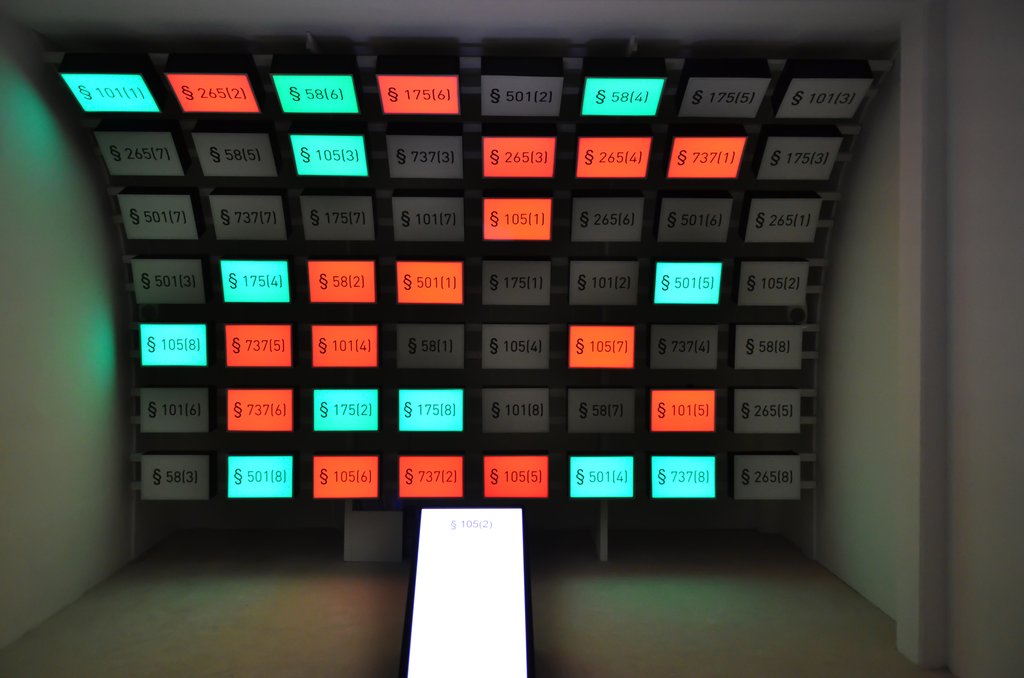
The interactive installation Memopol II (2010) in the upper exhibition space makes personal data from the Internet visible. Memopol II starts its Internet search by creating an identity card or passport and creates the user’s profile from digital traces of databases and websites. The user’s information field is displayed on a large control board which, in addition to information on the person’s popularity, also determines their possible date of death. The overpowering, physical presence of the materialized surveillance apparatus ironically comments on the subtle, everyday methods of data collection on the Internet, whose diversity, exploitation possibilities and storage criteria are not very transparent.
In his first major international solo exhibition Memopolis, Estonian artist Timo Toots creates the dark utopia of a city based on total surveillance. Similar to its literary and cinematic role models,
Toot’s fictional city of Memopolis shows tricky uses and the increasing extent of digital control on the internet. Liberated from secrets, because every expression of life is turned into data, the citizens of Memopolis emerge: perfect, absolutely transparent inhabitants who are kept alive by information flows. Data streams inexorably open up unexplored territories in the public and private spheres in order to anticipate and eliminate social deficiencies. Automated control apparatuses become the higher and moral authority in the evaluation and regulation of actions and thoughts.
Memopolis hardens the gloomy suspicion that contemporary technology has long since made it possible to realize the boldest categorization fantasies using data available on the Internet.